â€å“for the Second Time There Was No Sign Again No Bridegroom and the Priest in the House
The transformation of water into wine at the wedding at Cana (also called the wedlock at Cana, wedding banquet at Cana or marriage banquet at Cana) is the first miracle attributed to Jesus in the Gospel of John,[1] [2] although none of the synoptic Gospels mentions the wedding at Cana.
In the Gospel account, Jesus Christ, his female parent and his disciples are invited to a wedding. When his mother notices that the wine has run out, Jesus delivers a sign of his divinity by turning water into vino at her asking. The location of Cana has been subject to argue among biblical scholars and archaeologists; several villages in Galilee are possible candidates.
The account is taken every bit show of Christ's blessing of union and earthly celebrations, and has too been used equally an argument against teetotalism.
Biblical account [edit]
John 2:1–11[three] states that Jesus was at a wedding (seudat nissuin) in Cana with his disciples. Jesus' female parent (unnamed in the Gospel of John) told Jesus, "They accept no wine," and Jesus replied, "Adult female, what concern is that to you and to me? My hr has non withal come up." His female parent then said to the servants, "Do whatever he tells you." (John two:iii–v).[4] Jesus ordered the servants to make full containers with water and to depict out some and have information technology to the principal steward (waiter). After tasting information technology, without knowing where information technology came from, the steward remarked to the bridegroom that he had departed from the custom of serving the best wine first past serving it last (John ii:6–10).[5] John adds that: "Jesus did this, the showtime of his signs, in Cana of Galilee, and it revealed his celebrity; and his disciples believed in him" (John 2:11).[half-dozen]
Interpretation [edit]
The Wedding Banquet takes identify in Cana shortly afterwards the call of Philip and Nathanael. According to John 21:ii, Cana was Nathanael's hometown.[7]
Although none of the synoptic Gospels mentions the wedding at Cana, Christian tradition based on John 2:11[8] holds that this is the kickoff public miracle of Jesus.[9] Information technology is considered to accept symbolic importance every bit the first of the seven signs in the Gospel of John past which Jesus' divine status is attested, and around which the gospel is structured. Jesus will afterwards return to Cana, where John 4:46–54 describes him healing a Capernaum official'southward young son; the second sign in the Gospel of John.[seven]
The story has had considerable importance in the development of Roman Catholic theology. Bishop Fulton J. Sheen thought that it is very likely that information technology was ane of Mary'southward relatives who was being married. This would mean Mary and her relatives would be embarrassed if they appeared inhospitable by running out of wine, giving Mary a reason to ask Jesus to intervene. Sheen further suggests that as Jesus arrived with additional guests, they may accept contributed to the wines running brusque.[10] When his mother advises Jesus that their hosts are running out of vino, he says "Woman, what has this to exercise with me?" Sheen sees an echo of the Protevangelium of Genesis 3:15 "I will put enmity between you and the adult female, and between your offspring and hers", marking the commencement of Jesus' redemptive ministry.[10] Jesus will again address her as "Woman" in John 19:26, when he entrusts his female parent to his disciple John, "Woman, behold, your son."[7]
The gospel account of Jesus being invited to a wedding ceremony, attending, and using his divine power to relieve the celebrations from disaster are taken as prove of his approval for wedlock and earthly celebrations. It has also been used as an argument against the teetotalism good amidst certain Protestant Christian sects.[eleven]
Interpreted allegorically, the adept news and hope implied by the story are in the words of the steward of the Feast when he tasted the good wine, "Everyone serves the skillful vino first, and then the inferior wine later the guests have become drunk. Simply you accept kept the good wine until now" (John 2:x, RSV). This could be interpreted by saying just that it is e'er darkest before the dawn, but adept things are on the fashion. The more usual interpretation, however, is that this is a reference to the appearance of Jesus, whom the author of the Fourth Gospel regards as being himself "the good vino".[12] According to Pecker Day, the phenomenon may also be interpreted equally the antitype of Moses' commencement public miracle of changing water (the Nile river) into blood. This would establish a symbolic link between Moses as the showtime saviour of the Jews through their escape from Egypt and Jesus as the spiritual saviour of all people.[thirteen]
Some commentators take speculated about the identity of the unnamed benedict. 1 tradition, represented by Thomas Aquinas among others, holds that the benedict was St John the Evangelist himself.[ commendation needed ] Bishop John Spong suggests in his book Born of a Woman that the event was the wedding of Jesus himself to Mary Magdalene.[14] In 1854, at a fourth dimension when polygamy was an element of mainstream exercise of The Church of Jesus Christ of Latter-day Saints, the Latter-day Saint elder Orson Hyde fabricated a similar proposition, arguing that Jesus was a polygamist and that the result at Cana was his nuptials to Mary Magdalene, Martha and Mary of Bethany.[15] [16] [17] However, the idea that Jesus was married to Mary Magdalene is usually dismissed by scholars as pseudohistorical.[xviii]
Studying Jesus in comparative mythology, the story of the transformation of water into wine bears some resemblance to a number of stories that were told virtually the ancient Greek god Dionysus, who amid others was said to fill up empty barrels that had been left locked inside a temple overnight with wine.[19] However, scholars generally agree that the Gospel of John was written by a community of Jewish Christians who had recently been excommunicated past the local synagogue for recognizing Jesus as the Messiah, leading some to conclude that it would be making it unlikely the possibility that the Gospel was influenced by ancient Greek mythology.[20] Bart Ehrman argues that the thought that the image of Jesus was influenced by aboriginal pagan mythology is commonly dismissed by scholars every bit a fringe theory.[21]
The view of the valley view looking out towards Nazareth, from Khirbet Qana, would have predominantly been of grape vines, as archeologists have found testify of first century wine production.[22] The early sixth century writer Antoninus Placentinus observed almost Nazareth in his twenty-four hours: "it excels in wine and oil, fruits and beloved."[23] Then, if a miracle of turning water into vino had actually occurred at the site it would have probable have had allegorical significance for observers familiar with Greek mythology.
Identification of biblical Cana [edit]
The verbal location of "Cana in Galilee" (Aboriginal Greek: Κανὰ τῆς Γαλιλαίας, Kana tēs Galilaias ) has been discipline to debate amid scholars.[24] Mod scholars maintain that since the Gospel of John was addressed to Jewish Christians of the time, it is unlikely that the evangelist would mention a identify that did not exist.[ commendation needed ] All the same, Dominican scholar Jerome Irish potato-O'Connor cautions that Cana is a very common name, with no known text offer whatever inkling every bit to which of the dozen towns going by the name would be the correct one, and calls the mutual choice of Kafr Qanna most Nazareth "probably merely a pious judge".[25]
The main candidates for the town from the Gospel of John are:
- Kafr Kanna, in Galilee[26]
- Khirbet Qana, also in Galilee, considered to be the more likely candidate[26] [27]
- Qana, Southern Lebanon,[25] in an area that was part of historical Galilee
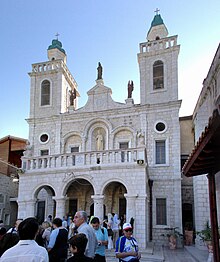
Co-ordinate to the Catholic Encyclopedia of 1914, a tradition dating dorsum to the 8th century identifies Cana with the modern Arab town of Kafr Kanna, in Galilee, nigh seven km (4.3 mi) northeast of Nazareth,[28] in today's Israel.
The ruined hamlet of Khirbet Qana (Kanet el-Jelil), about 6 miles (9 km (5.6 mi)) further northward,[29] is an pick presented as certain by William F. Albright in 1923,[thirty] whose name "Qana" is also etymologically closer to Cana than "Kanna".[26]
Some Lebanese Christians, especially the Lebanese Melkites (Greek Catholics), supported by their Church, believe the southern Lebanese village of Qana to have been the bodily location of this event.[25]
The spring of 'Ain Kanah ("Kanah Spring") most the village of Reineh, immediately northeast of Nazareth, has been proposed equally an equally likely site by Conder in 1878,[31] only has little going for information technology and has been rejected in more recent scholarship equally a candidate.[27]
Rock jars [edit]
Many throughout history have sought to recover the lost jars. On December 21, 2004, archaeologists reported finding in Kafr Kanna "pieces of large stone jars of the type the Gospel says Jesus used when he turned water into wine".[32] But American scientists excavating the rival site of Khirbet Qana north of information technology, also claimed to have found pieces of stone jars from the time of Jesus.[32] Fellow archaeologist Shimon Gibson bandage doubtfulness on the value of such finds for identifying the town meant by John, since such vessels are not rare and it would be impossible to link a detail set of vessels to the miracle.[32] "Just the existence of stone vessels is non enough to prove that this is a biblical site."[32] Several stone jars of the blazon described by the Gospel of John were constitute for instance in Jerusalem: "At least half dozen of them stood in the basement kitchen of the [first-century CE] 'Burnt house'. They were shaped and finished on a very big lathe, given a pedestal pes and simple decoration. Such stone jars would hold large quantities of water for washing and kitchen needs. Apartment discs of rock served as lids. The jars at Cana may have been similar to these", wrote Alan Millard.[33]
Vino or beer [edit]
In the journal Biblical Archaeology Review, Michael Homan argues that many biblical scholars have misinterpreted early on texts, translating to 'wine' when the more sensible translation is 'beer'.[34] However, this has been dismissed by other writers, who point out that the Greek oinos always means vino, and that the discussion sikera was available if the gospel author wanted to refer to barley beer.[35] [36] [37]
In fine art [edit]
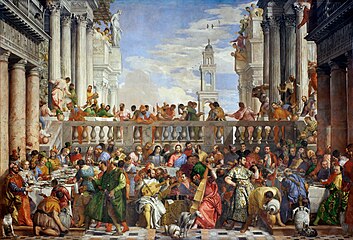
Depictions of The Wedding/Marriage at Cana are numerous in art history.
Other [edit]
Sixth-century Irish missionary, Saint Columba of Iona, supposedly performed an identical miracle when he served as a deacon in Ireland under Finnian of Movilla, replenishing the supply of sacramental wine for a mass.[39]
Run across also [edit]
- Chronology of Jesus
- Life of Jesus in the New Attestation
- Ministry of Jesus
- Miracles of Jesus
Further reading [edit]
- Knecht, Friedrich Justus (1910). . A Practical Commentary on Holy Scripture. B. Herder.
References [edit]
- ^ van der Loos, Hendrik (1965). The Miracles Of Jesus. Brill Archive. p. 590. GGKEY:ZY15HUEX1RJ.
- ^ Royster, Dmitri (1999). The Miracles of Christ. St Vladimir's Seminary Press. p. 71. ISBN978-0-88141-193-5.
- ^ John 2:1–xi
- ^ John ii:three–v
- ^ John 2:vi–10
- ^ John 2:11
- ^ a b c Winstanley, Michael T. (2008). Symbols and Spirituality: Reflecting on John's Gospel. Don Bosco Publications. pp. 8–. ISBN978-0-9555654-0-3.
- ^ John 2:11
- ^ Towner, W. S. (1996). "Hymeneals". In P. J. Achtermeier (ed.). Harper Collins Bible Lexicon. San Francisco: Harper. pp. 1205–1206.
- ^ a b Sheen, Fulton J. (1952). "The Marriage Feast At Cana, in The Globe's First Love". www.catholictradition.org.
- ^ Geisler, North. L. (1982). "A Christian Perspective on Wine-Drinking". Bibliotheca Sacra. 49.
- ^ Smith, D. M. (1988). "John". In Mays, J. L. (ed.). Harper'south Bible Commentary. San Francisco: Harper. pp. 1044–1076.
- ^ Twenty-four hour period, Nib (1997). The Moses Connection in John's Gospel. Mariner. ISBN0-9662080-0-5.
- ^ Spong, John Shelby (1992). Born of a Woman. Harper. pp. 187–199.
- ^ Hyde, Orson (6 October 1854), "Conference message", Journal of Discourses, 2: 82
- ^ Abanes, Richard (2007). Within Today'south Mormonism. p. 239. ISBN978-0-7369-1968-five.
- ^ Roberts, E (2011). A Disparity in Doctrine and Theology. p. 54. ISBN978-1-4497-1210-5.
- ^ Ehrman, Bart D. (2004). Truth and Fiction in The Da Vinci Code: A Historian Reveals What We Really Know almost Jesus, Mary Magdalene, and Constantine. USA: Oxford University Press. ISBN978-0-19-518140-1.
- ^ Pollmann, Karla (2017). "Jesus Christ and Dionysus: Rewriting Euripides in the Byzantine Cento - Oxford Scholarship". Oxford Scholarship Online. doi:10.1093/acprof:oso/9780198726487.001.0001. ISBN978-0-19-872648-7.
- ^ Hurtado, Larry W. (2005). How on Earth Did Jesus Become a God?: Historical Questions about Primeval Devotion to Jesus. Wm. B. Eerdmans. ISBN978-0-8028-2861-iii.
- ^ Ehrman, Bart D. (2012-03-twenty). Did Jesus Exist?: The Historical Argument for Jesus of Nazareth. Harper Collins. ISBN978-0-06-208994-6.
- ^ Moore, Michael (2008-02-16). ""What good affair can come out of Nazareth?" (updated)". University of the Holy Land . Retrieved 2021-08-xi .
- ^ Goor, Asaph (1966). "The History of the Grape-Vine in the Holy Land". Economic Phytology. 20 (one): 46–64. doi:10.1007/BF02861926. ISSN 0013-0001. JSTOR 4252702. S2CID 44623301.
- ^ Charlesworth, James H. (2006). Jesus and Archaeology. Wm. B. Eerdmans. pp. 540–541. ISBN978-0-8028-4880-2.
- ^ a b c Salameh, Rima (29 January 1994). "Lebanese Town Lays Merits To Jesus Christ'south First Miracle". Tulsa Globe . Retrieved 21 June 2021 – via Associated Press.
- ^ a b c Reed, Jonathan Fifty. (2000). Freedman, David Noel; Allen C. Myers (eds.). Cana (Gk. Kaná). Eerdmans Dictionary of the Bible. Amsterdam University Printing. p. 212. ISBN978-90-5356-503-2 . Retrieved 15 July 2021.
- ^ a b Laney, J. Carl (1977). The Identification of Cana of Galilee (PDF). Selective Geographical Problems in the Life of Christ (doctoral dissertation) (Thesis). Dallas Theological Seminary. pp. 91–92. Retrieved 15 July 2021.
- ^ Ward, Bernard (1908). . In Herbermann, Charles (ed.). Catholic Encyclopedia. Vol. 3. New York: Robert Appleton Company.
- ^ Ward, Bernard (1908). "Cana". Catholic Encyclopedia. New York: Robert Appleton Co. Retrieved sixteen July 2021 – via Catholic Answers.
- ^ Albright, Westward. F. (October 1923). "Some Archaeological and Topographical Results of a Trip through Palestine". Bulletin of the American Schools of Oriental Research. The University of Chicago Press on behalf of The American Schools of Oriental Research. 11 (xi): 3–14 (see p. 11). doi:10.2307/1354763. JSTOR 1354763. S2CID 163409706.
- ^ Conder, Claude Reignier (1878). Tent Piece of work in Palestine: A Record of Discovery and Gamble. R. Bentley & Son. p. 154.
- ^ a b c d "Archeologist says she's found site of Jesus' first phenomenon". NBC News Digital. The Associated Press. 21 December 2004. Retrieved fifteen July 2021.
- ^ Millard, Alan (1997). Discoveries from Bible Times: Archaeological Treasures Throw Light on the Bible. King of beasts Books. p. 184. ISBN9780745937403 . Retrieved 15 July 2021.
- ^ Homan, Michael 1000. (2010). "Did the Ancient Israelites Drink Beer?". Biblical Archaeology Review.
- ^ Kneale, Stephen (November 23, 2016). "Did Jesus actually turn water into beer?". Building Jerusalem.
- ^ Rao, Bandari Prabhaker (2010). The Missiological Motifs of the Miracles of Jesus Christ. ISPCK. p. 33. ISBN9788184650259 . Retrieved xiv April 2010.
- ^ Saarnivaara, Uuras (April 29, 2008). Tin can the Bible Be Trusted?: Old and New Attestation Introduction and Interpretation. Wipf and Stock. ISBN9781556356995.
- ^ "Bruiloft te Kana". lib.ugent.exist . Retrieved 2020-09-28 .
- ^ Adomnan of Iona (1995). Life of St Columba. Penguin.
External links [edit]
- Shea, Mark. "The Significance of the Nuptials at Cana", National Catholic Register, September 10, 2012
Source: https://en.wikipedia.org/wiki/Wedding_at_Cana
0 Response to "â€å“for the Second Time There Was No Sign Again No Bridegroom and the Priest in the House"
Post a Comment